What would make this month useful to you?
Let’s start with something you actually want help with.
Maybe there’s something you’ve wanted to learn, but every explanation leaves you with more questions. Maybe you have an idea you’re excited about and no clue where to start. Or maybe you just need a little help getting through the work already in front of you.
That’s where I want to start with AI. With something that matters to you.
I want SynaptechAI to be a place where we can figure out what that help looks like. And part of that is understanding what’s happening when a tool gives us an answer.
What is it actually doing?
When you use an AI assistant built around a large language model, the model works with tokens: pieces of text that can be whole words, parts of words, or punctuation. It uses patterns learned during training, along with the context available for your request, to generate a response. In text generation, that response develops a token at a time. Google’s language-model introduction explains the underlying idea: estimating which tokens fit a sequence.
That sounds small for something that can explain a difficult concept or help write code. But those learned patterns can support much more than finishing familiar phrases. They capture relationships among ideas, language, and examples.
Here’s the practical catch: producing a plausible sentence and establishing that the sentence is true are different operations. A confident answer doesn’t tell you whether anyone checked its claims.
We’ve run into that ourselves. Some of our AI-assisted research contained claims we couldn’t support, and we had to remove them. The wording was convincing. The evidence wasn’t there.
So I want us to get comfortable asking two questions: What can this help me produce? And what will I need to check?
Give yourself a task you can learn from
Suppose you want to understand a confusing set of instructions. You could paste the instructions and ask:
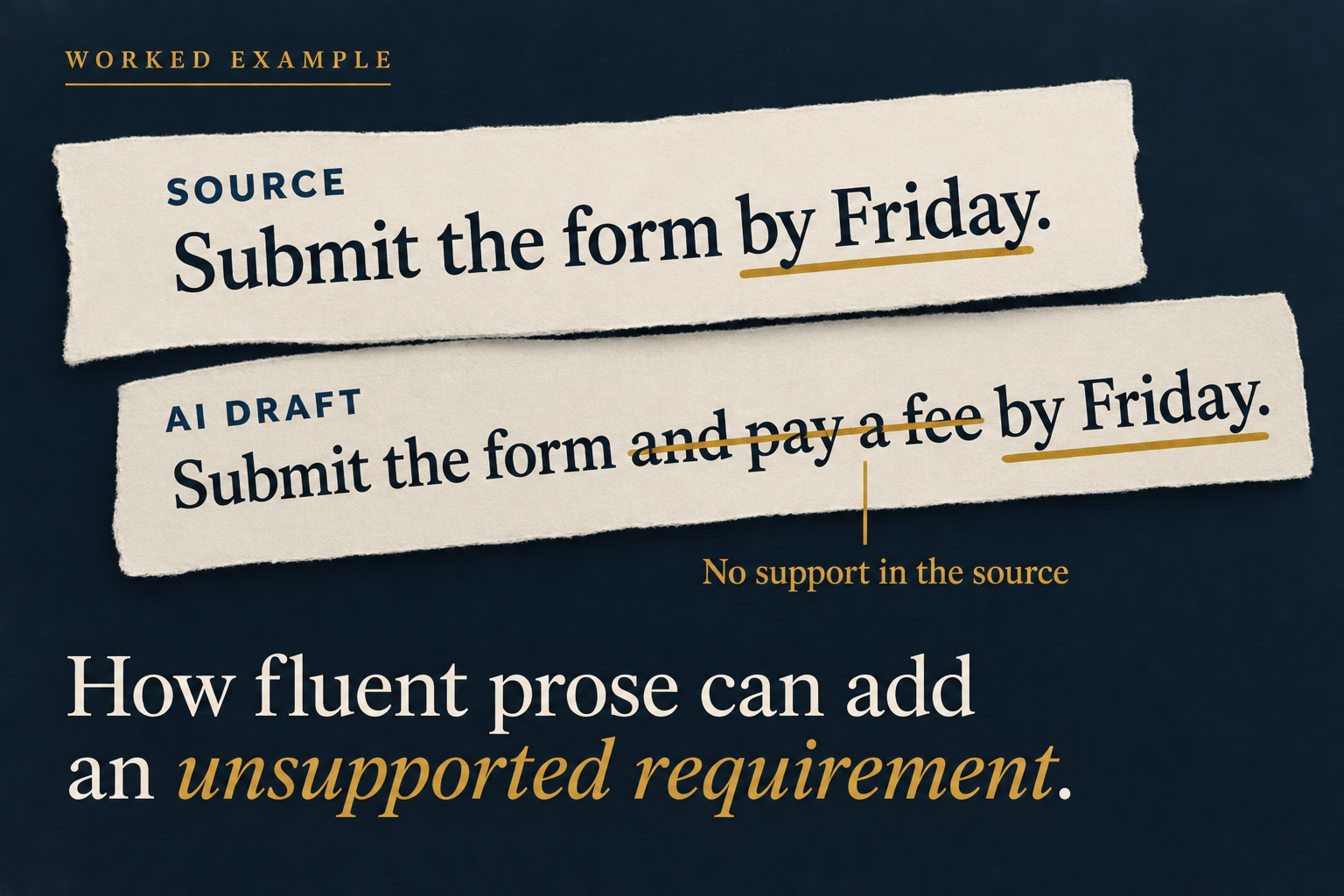
Explain what I need to do, in order. For each step, show which part of the instructions it comes from. If something is missing or ambiguous, point it out.
This gives you a useful way to inspect the answer. You can compare each proposed step with the original. If the assistant adds a requirement that isn’t there, you have something specific to question.
Notice what makes this manageable. There’s a defined piece of work, a source to work from, and a way to judge the result. You don’t have to decide whether AI is trustworthy in every situation before finding out whether it can help with this one.
For learning, your check might be whether you can explain the idea in your own words and work through a new example. For planning, it might be whether the next action fits the time and resources you actually have. The check should belong to the task.
Over the next month, we’ll build on that: giving useful context, checking answers, exploring ideas, and deciding what’s worth keeping. I’ll share what we’re learning as we build. When we’re exploring something we haven’t tested, you’ll know.
What would you like to be able to do a month from now that you’re having trouble with today?
Bring that with you. It gives the rest of this series somewhere to land.
New here? Read our welcome article or explore the interactive companion.
Tomorrow: Give AI a little background.