Give AI a little background
Help it understand the job you’re actually doing.
Imagine asking a coworker to finish something you started yesterday. They haven’t seen your notes. They don’t know what you ruled out. They don’t even know who it’s for.
“Just pick up where I left off” is asking quite a lot.
An AI assistant has its own version of this problem. To understand why, it helps to separate what the model learned during training from what it has available for this particular response.
Training shapes the model’s learned patterns. Context is the material supplied for the current request: instructions, conversation, documents, and possibly results from tools. The context window is the finite amount the model can work with at once, measured in tokens. Anthropic’s context-window documentation describes this distinction.
An app may save older conversations, summarize them, or retrieve relevant material. Those features determine what reaches the model. A document existing somewhere in your account doesn’t, by itself, establish that its contents are available in this response.
That’s why “I told it last week” and “it has that information now” aren’t necessarily the same thing.
What background makes a difference?
In one of our handoffs, the next AI response used the research we carried forward and rejected an argument the evidence didn’t support. That’s the kind of continuity I want: previous work affecting what happens next. We still had to review the result.
You can give that continuity a starting point with three things.
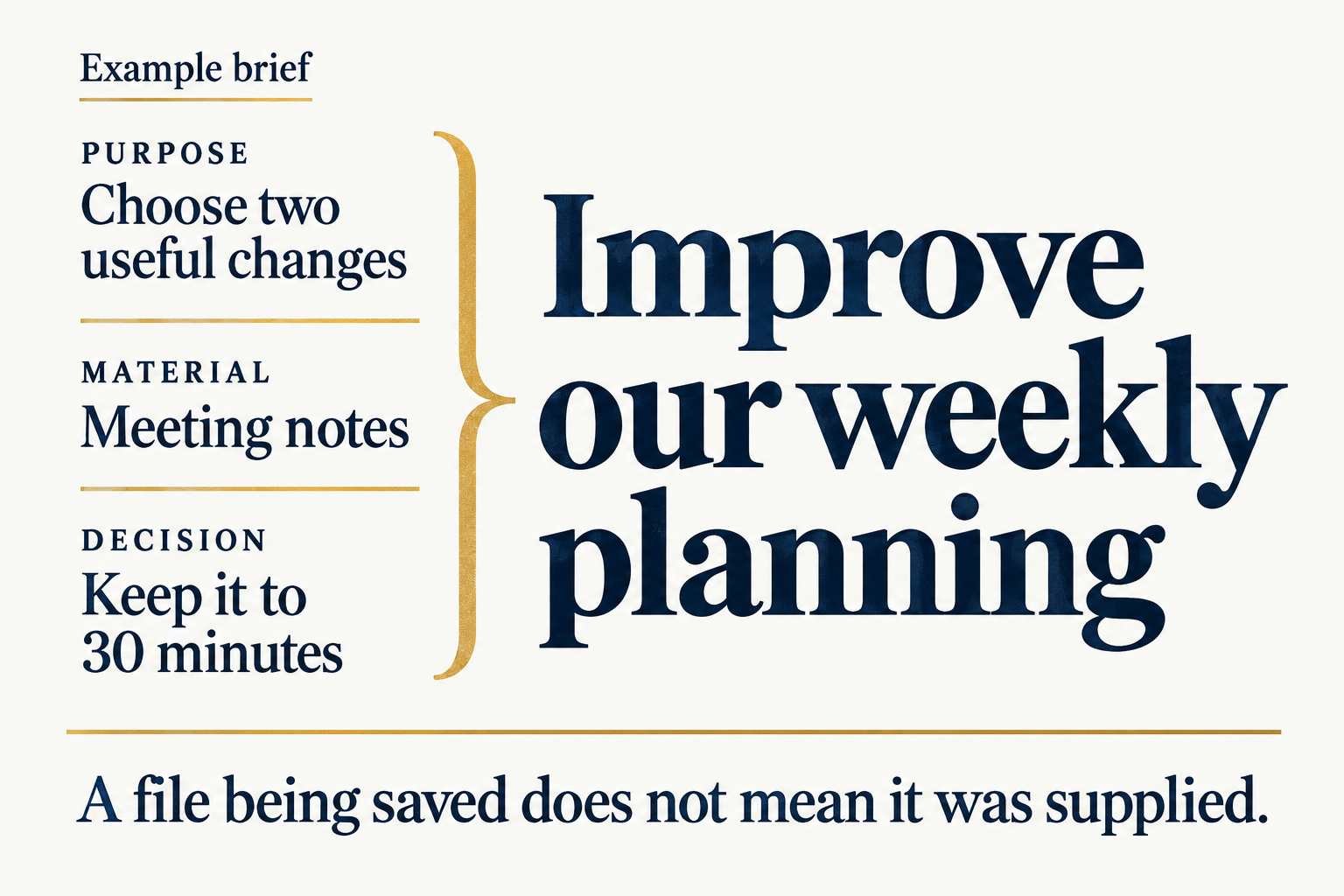
The purpose tells it what matters. “Summarize this report” leaves the emphasis open. “Summarize this report so I can decide whether to change our weekly process” gives the summary a job.
The material gives it something to ground the answer in. Include the relevant report or passage. Asking for a summary of a document the assistant hasn’t actually received creates an avoidable information gap.
The decisions prevent old questions from being treated as new ones. If you’ve already ruled out an option, say why. If a newer decision replaces an older one, identify the current decision instead of expecting the assistant to resolve the conflict correctly.
Here’s an example you could adapt:
I’m deciding whether our weekly planning process needs to change. Use the notes below. We’ve already decided to keep the meeting to 30 minutes, so don’t propose extending it. Identify two changes supported by the notes, explain the tradeoffs, and flag anything we would need to find out first.
Each sentence removes a different kind of ambiguity: the goal, the evidence, the constraint, and the expected reasoning.
More material isn’t automatically more help
It’s tempting to solve every context problem by pasting everything. But relevant information can still be used unevenly. In the 2023 study Lost in the Middle, performance on the researchers’ tasks depended partly on where useful information appeared in a long input. The tested models often did worse when it sat in the middle. That’s a finding about those experiments, not a score for every assistant today.
My practical takeaway is to make the important material easy to identify. Name the current decision. Label the source. Leave out unrelated history.
Then check whether the response actually used it. Did it respect the 30-minute limit? Can you trace its recommendations to the notes? A cheerful “understood” isn’t that check.
Tomorrow: What would finished look like?