Has anything actually changed?
A new-looking result doesn’t always need a new decision.
You reopen a page and something looks different. Or an assistant tells you it found an update. Now what?
Before changing your plan, it helps to separate three questions:
Did the file change? Did the information change? Does that change matter to what I’m doing?
Those questions sound similar. They can have very different answers.
A web page contains more than the sentences you read. Its underlying HTML can include navigation, formatting, and other material around the main content. Some of that can change while the information you came for stays the same.
That happened in one of our source checks. The page’s HTML had changed, but the extracted text matched the earlier copy. We hadn’t found a substantive change in the text we checked. Treating it as new information would have overstated the result.
How a comparison works
You need a baseline: the earlier version you’re comparing against. Without it, you may be able to say what a page says now, but you can’t reliably show what changed.
Software can compare files using a hash, a compact value calculated from their contents. A cryptographic hash such as SHA-256 acts like a fingerprint for the exact data supplied to it. Different hashes establish that those inputs differ; matching hashes provide very strong practical evidence of identical input, although collisions are mathematically possible. NIST’s hash-function glossary explains these properties.
But a hash doesn’t interpret meaning. A changed space and a changed deadline can both produce a different fingerprint.
A diff goes a step further by showing differences between versions. You can then inspect the actual change and decide what follows from it.
Consider three hypothetical updates:
| What changed | What it could mean for you |
|---|---|
| A sentence was moved, with its wording unchanged. | The page was reorganized; your decision may still stand. |
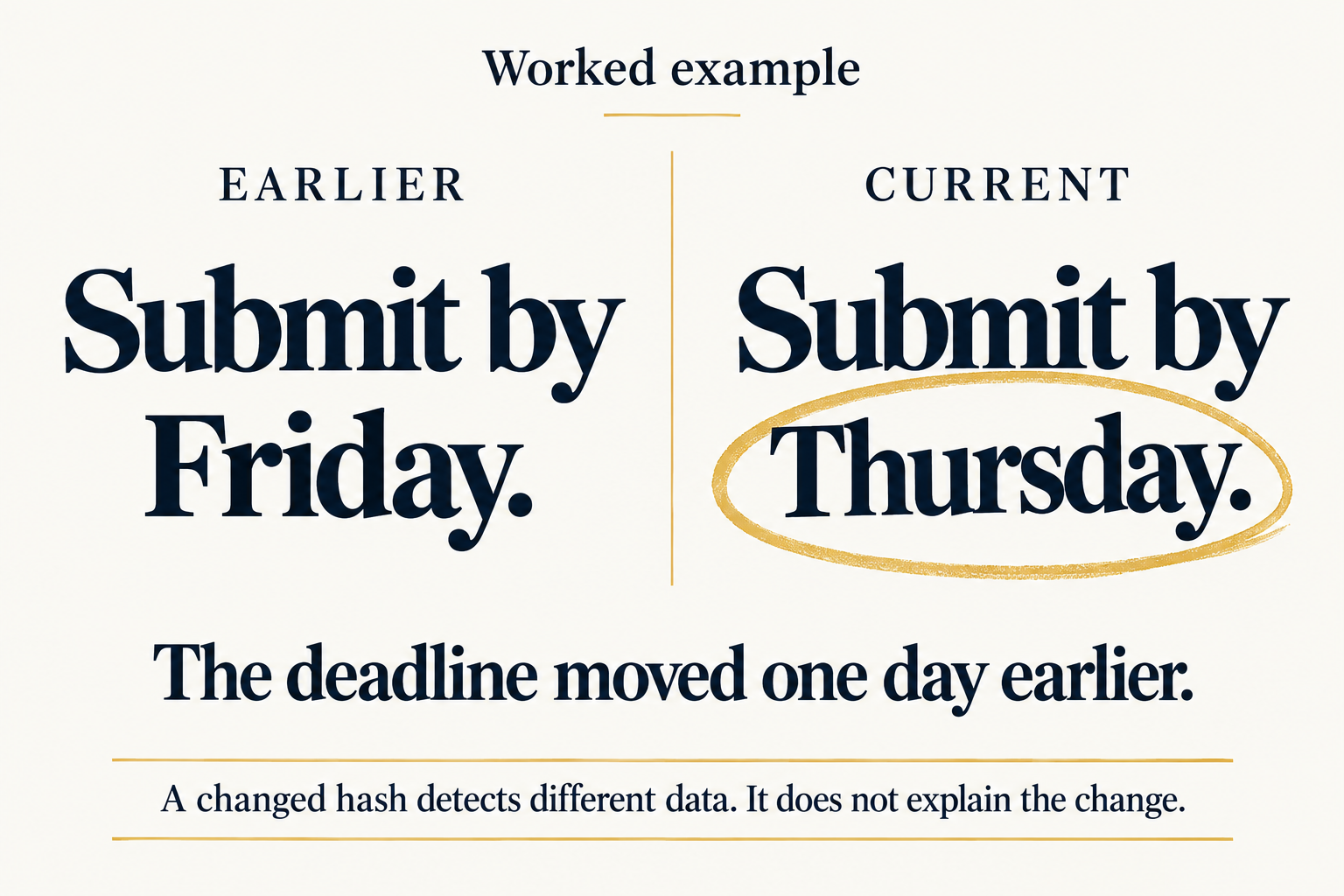
| “Submit by Friday” became “Submit by Thursday.” | Your plan may need an earlier deadline. |
| “All applicants” became “New applicants.” | The instruction may no longer apply to everyone. |
The size of an edit tells you very little about its importance. One word can change who an instruction applies to.
Keep the comparison attached to the question
For a practical source review, ask the assistant to show the earlier wording, the current wording, and the effect on your decision. That lets you inspect the reasoning instead of accepting “updated” as a conclusion.
Also pay attention to what was compared. Matching extracted text tells you about that text. It doesn’t establish that an image, downloadable attachment, or omitted table stayed the same. If the information you need lives there, it belongs in the check.
And if the source couldn’t be retrieved, the result is unknown. A failed check tells you nothing about whether the content changed. Our own source-check record includes a failed retrieval before a successful capture; those were separate outcomes.
This is where judgment enters the process. Software can point to a difference. You still need to connect that difference to the work in front of you.
Tomorrow: The missing piece can change the meaning.