Would someone actually use this?
A promising idea gives us a question worth investigating.
Suppose you have an idea for an AI tool. You describe it, ask an assistant who might want it, and get back a polished explanation of the problem, the audience, and the business opportunity.
It all fits together.
But where did the evidence of demand come from?
In our own research, we had to withdraw unsupported claims about the market, pricing, and return on investment. We still had possible directions to investigate. We didn’t have enough evidence to call them validated demand.
That distinction changes what the next step should be.
Turn the idea into something you could be wrong about
“People need help with follow-up” is broad enough to feel true without telling us much.
Here’s a hypothetical, more specific version:
Small service businesses lose track of quote follow-ups because the work is split across messages and notes, and the problem happens often enough that they want a different process.
This contains several hypotheses: claims we could investigate. The problem exists for a particular group. The proposed cause is correct. The frequency matters. People want to change how they handle it.
If any of those fail, the solution may need to change too.
That’s why customer discovery focuses on learning from potential customers and other people involved in the work. NSF’s I-Corps program uses direct conversations with customers, partners, and industry stakeholders to evaluate commercial potential.
Here’s how I would approach that hypothetical follow-up idea. This is a proposed investigation, not customer research we’ve completed.
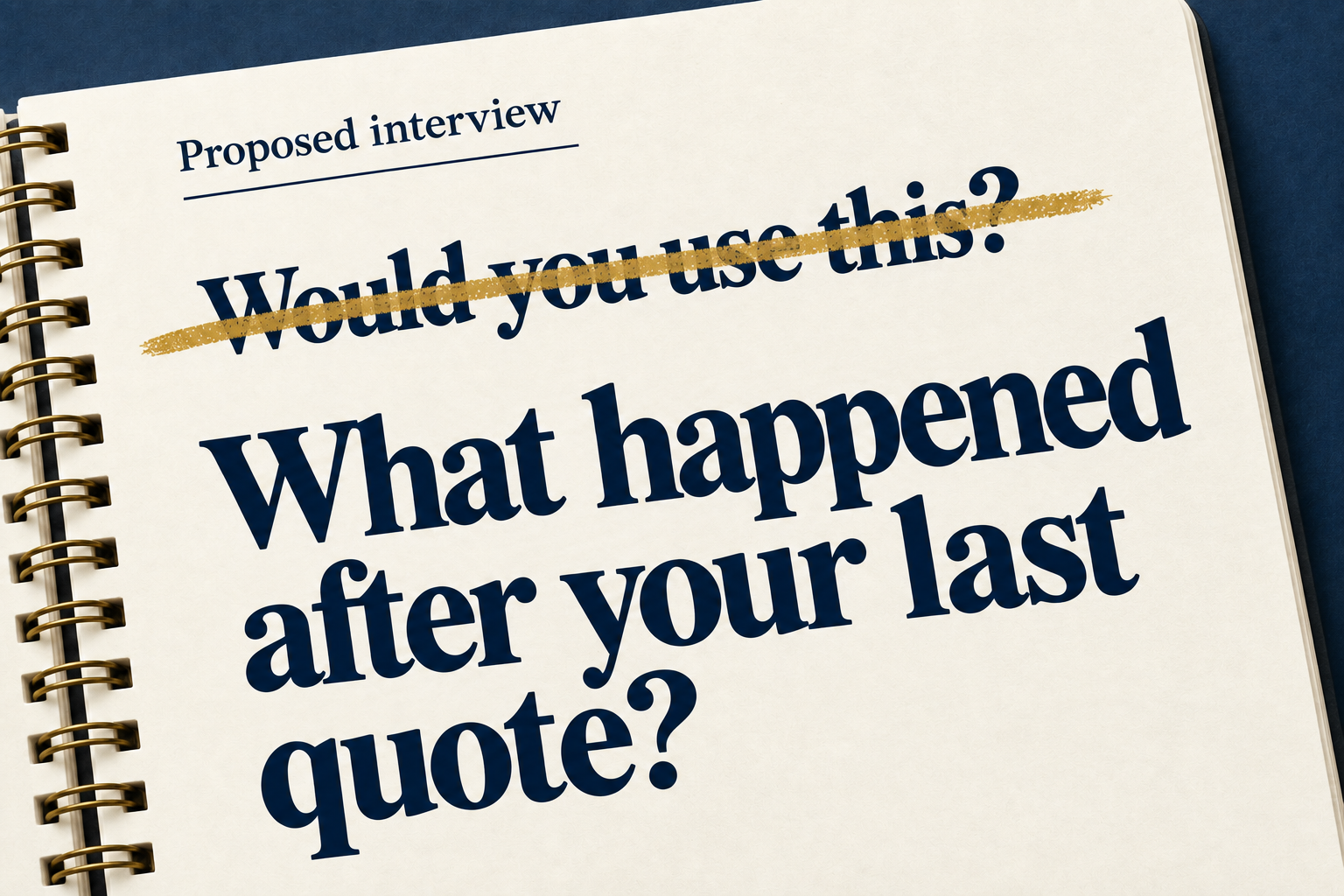
I’d begin with a recent real event: “Walk me through the last quote you sent. What happened afterward?” Then I’d ask where the information lived, who took the next action, and what happened if nobody followed up.
Those questions give the person room to describe a process that may contradict our assumption. Perhaps the information is already organized. Perhaps slow follow-up isn’t the problem. Perhaps the owner has a workable solution and no reason to replace it.
“Would you use an AI tool that fixes this?” gives us less to examine. A friendly yes doesn’t show the problem’s frequency, the cost of changing routines, or willingness to pay.
Different evidence answers different questions
A conversation can help explain a person’s process. An example of their current workaround can make the problem more concrete. A trial can show whether a proposed solution fits the work. A purchase provides evidence that someone was willing to pay under those conditions.
None of those answers every question.
One purchase doesn’t establish a large market. One enthusiastic interview doesn’t establish a purchase. And if you talk only to people who already love AI, you may miss reasons other potential users would avoid your tool. That’s a sampling problem: who you hear from affects what you can reasonably conclude.
AI can help prepare questions, organize notes, and identify competing explanations to investigate. But a simulated customer’s answer comes from the model. It isn’t an interview with someone who actually has the problem.
Before testing an idea, I’d write down what would weaken it. If people rarely encounter the problem, already solve it easily, or won’t try a different process, those are useful findings.
You can still like the idea. You just have a better basis for deciding what to do with it.
Tomorrow: Is this actually helping?