Turn rough notes into a shape you can change
An outline should help you make decisions before you spend time polishing sentences.
Five notes on a page can be the beginning of something useful. They can also become five polished paragraphs that still don't belong together.
That is the first choice I want to slow down this week. Before asking AI to expand your notes, decide what the reader should be able to do with them. Otherwise, the model can organize around familiar headings while leaving your actual problem untouched.
Last week we worked on choosing a task, providing context and checking an answer. Let's use those habits to make something: a short guide another person could follow. Bring your own task along. I'll use a small, constructed example throughout this week—a guide for checking whether a saved source needs an update. It draws on our source-checking work, but these sample notes are written for the exercise.
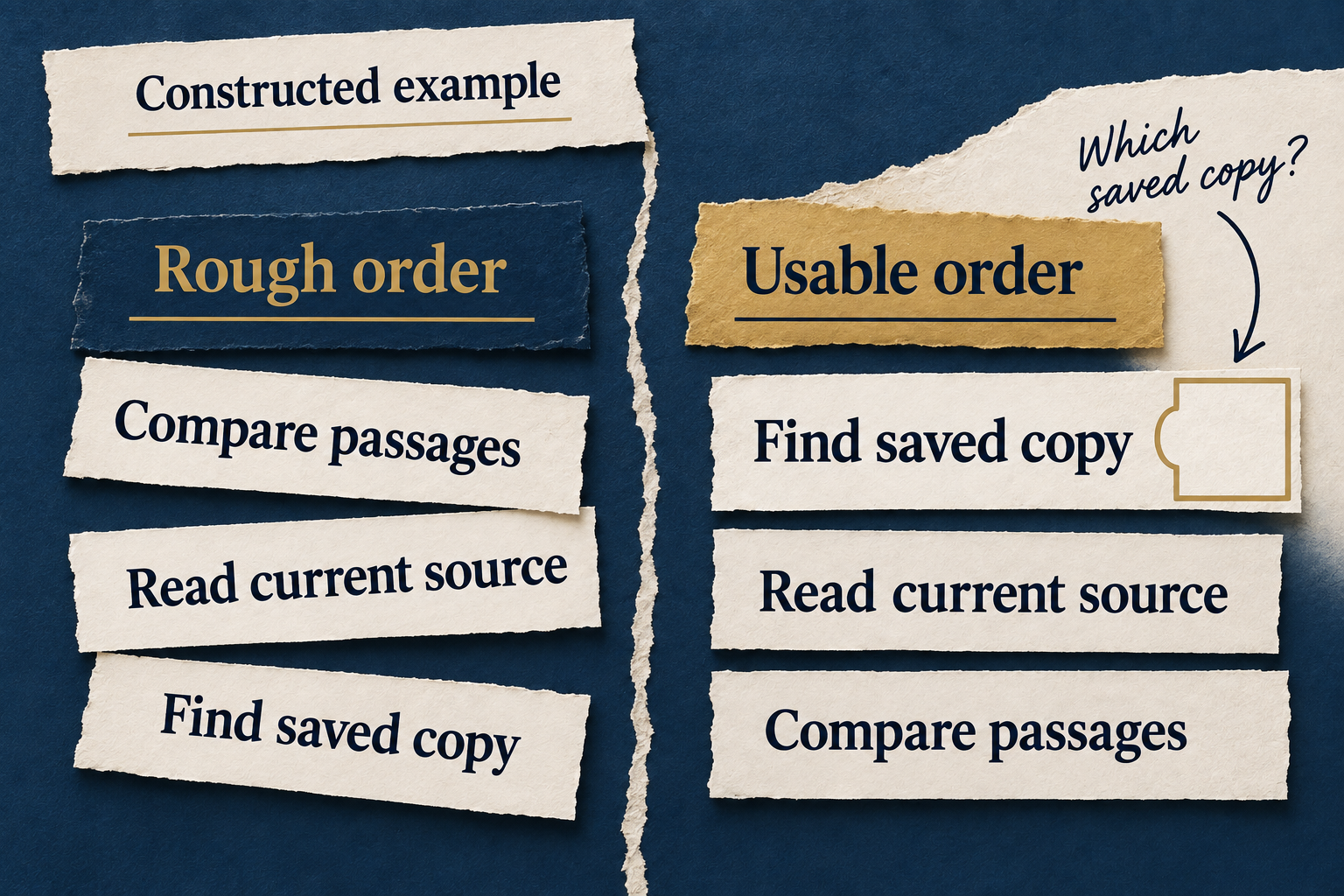
The illustration shows the smallest version of this problem. The same three instructions become more usable when finding the saved copy comes before comparing the passages. That still leaves a question: which saved copy? Rearranging words can expose the missing input; it cannot supply it.
Here are the fuller notes:
- Keep the earlier version.
- Sometimes a webpage won't open.
- A changed page doesn't always mean changed advice.
- Record when the check happened.
- Read the part that supports the decision.
We could give each note a heading. But look at the order. We are asking someone to preserve an earlier version before explaining why they need one. We mention a failed page without saying what that means for the result. The ingredients are here; the relationships need work.
Put the reader's decisions in order
The guide needs to answer a sequence of questions: Which source am I checking? What am I comparing it with? Can I inspect the relevant content? Did its meaning change? What should happen next?
Now the notes have jobs. The earlier version supplies the comparison. An inaccessible page creates an unresolved check. A changed passage requires a judgment about the advice it supports. The date tells us when that judgment was made.
That sequence exposes something missing: we never said who decides whether the working guidance should change. An outline has already helped before producing a paragraph.
In our own watched-source procedure, the starting conditions mattered: the operator needed the right source and its saved comparison material. We also included a recovery route for a wrong reference. “Check the source” was too broad to carry that work by itself.
Here's the kind of request I'd use for the example:
Organize these notes into a short guide for someone checking a saved source. Arrange the steps around the decisions they must make. Keep the meaning of each note. Point out missing information instead of inventing a rule or an owner.
An instruction like that makes the proposal easier to examine. It doesn't guarantee that the model preserves every condition. Put the outline beside the notes and check what moved, what disappeared and what was added.
Leave room to disagree
You can ask for two possible structures if you are choosing between them. One might follow the order of the work. Another might start with the three possible outcomes: unchanged, changed or unresolved. Those serve different readers. The first helps a newcomer do the task; the second helps an experienced person interpret a result.
Our procedure-writing approach separates prerequisites, actions and exceptions for this reason. Each answers a different question. You don't have to use those words as headings, but the information needs a home.
For today, keep the output small enough to rearrange. Circle the missing decision before you approve the order. Tomorrow we'll expand part of this guide and see what fluent sentences can hide.