A first draft is something to examine
Read for what the instructions would cause someone to do.
“Review the source, make any necessary updates and save the revised version.”
That sounds reasonable. It is also doing a remarkable amount of hiding.
Which version? Necessary according to whom? What if the page cannot be opened? Are we changing our notes, or changing guidance someone else relies on?
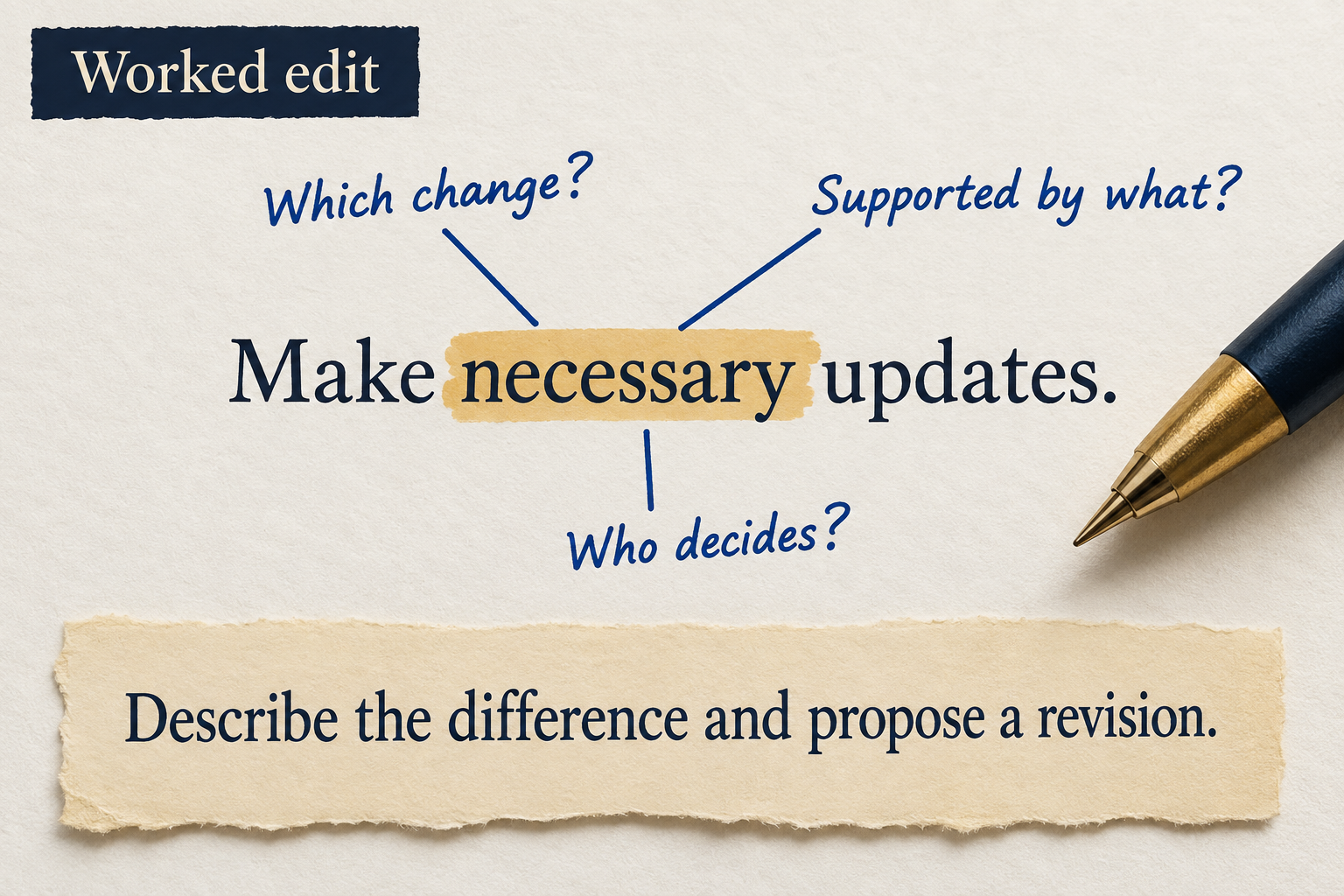
This is where a first draft becomes useful to me: it gives us something specific to question. Yesterday's outline made the order visible. A draft makes the assumptions visible—if we look past how smoothly it reads.
Let's stay with our example guide for checking a saved source. The sentence above is a deliberately weak example, not a recorded model response. Its problem isn't grammar. Its verbs allow several very different actions to pass as the same instruction.
Follow the verbs
Start with “review.” A person could open the page, read its title and believe they have reviewed it. But our intended task requires comparing the relevant passage with the saved version. We need to say what gets compared.
Next, “make any necessary updates.” That jumps from noticing a change to accepting it. The source may have added a caveat. That could justify narrowing one sentence in our notes; it doesn't automatically justify rewriting everything we believe about the topic.
Finally, “save.” Saving a new file is easy. Preserving the old evidence, naming the current version and making the decision discoverable are separate parts of the job.
A more usable passage might read:
Open the source and the saved version used for your earlier notes. Compare the passage that supports the decision you are reviewing. If you cannot inspect that passage, record the check as unresolved. If the meaning changed, describe the difference and propose the affected edit for review. Keep the earlier version with the record of the check.
That takes more words. Every addition answers a question the short version left to guesswork.
You can overdo this, of course. A simple personal reading note does not need a corporate approval chain. Include the decisions that matter to the task, and leave out ceremony that serves no purpose.
Review the claim before the wording
We saw this distinction in a comparison of different AI working arrangements. One writer used an earlier research memo but rejected an unsupported reason for its recommendation. The handoff worked because the material could be challenged. It still needed correction afterward; passing work between models did not settle its accuracy.
That experience is why I would ask for a critique with a narrow job:
Identify instructions that depend on information the reader has not been given. For each, explain what someone might do incorrectly and what information would resolve it.
Then inspect the critique. An AI reviewer can invent a problem, miss a real one or propose more process than the task needs. Its answer is another contribution to review.
The research gives us a reason to be precise about what “working together” means. A 2024 meta-analysis of human–AI experiments found that combinations improved on humans alone on average, but did not outperform the better of the human or AI alone on average. The studies covered different tasks and systems through June 2023. That isn't a verdict on your draft; it challenges the assumption that adding a reviewer automatically produces a better result.
For your own draft, pick one paragraph and follow its verbs. What would a person actually do? What would they need to know first? Where might two reasonable readers take different paths?
Fix that before replacing ordinary words with impressive ones. A sentence can be graceful and still send someone in the wrong direction.