Keep the sentence that sounds like you
Voice lives in what you notice, what you mean and what you are willing to say.
There is a kind of sentence that sounds perfectly professional until you try to imagine a person saying it.
“Implement a comprehensive verification strategy to ensure optimal informational reliability.”
I would rather say, “Open the source before you build a decision on it.”
Those sentences aren't just dressed differently. The second tells someone what to do. It puts the consequence close to the action. The first leaves the reader holding a collection of respectable words.
When AI helps with writing, “make this better” leaves a lot undecided. Better for whom? A close friend, a new reader and a technical reviewer may need different language. If you haven't chosen the relationship with the reader, a polished rewrite can choose it for you.
Give the rewrite a job
Our source-checking guide from the last two days has a practical purpose. Its voice should help someone act without feeling talked down to. We can be warm and exact at the same time.
Consider three constructed versions of the same idea:
Formal: An inaccessible source does not establish the absence of a substantive change.
Conversational: If the page won't open, we don't know whether it changed.
Instructional: Mark the check unresolved when you can't inspect the source. Keep the last verified version available.
I might use the first in a technical explanation, the second while introducing the problem and the third in the procedure itself. Choosing a voice isn't choosing one register forever. It is choosing language that serves this moment.
Our brand guidance puts clarity and usefulness at the center of how we communicate. Applied here, that means a reader shouldn't have to decode our professionalism before reaching the point.
Ask for a smaller edit
Try asking AI to identify an unclear sentence before asking it to rewrite the entire piece. You retain the surrounding rhythm and can decide whether the suggested repair actually helps.
Point out where this passage becomes vague or difficult to follow. Suggest a small revision to each affected sentence. Preserve concrete examples, contractions and the strength of the original claims.
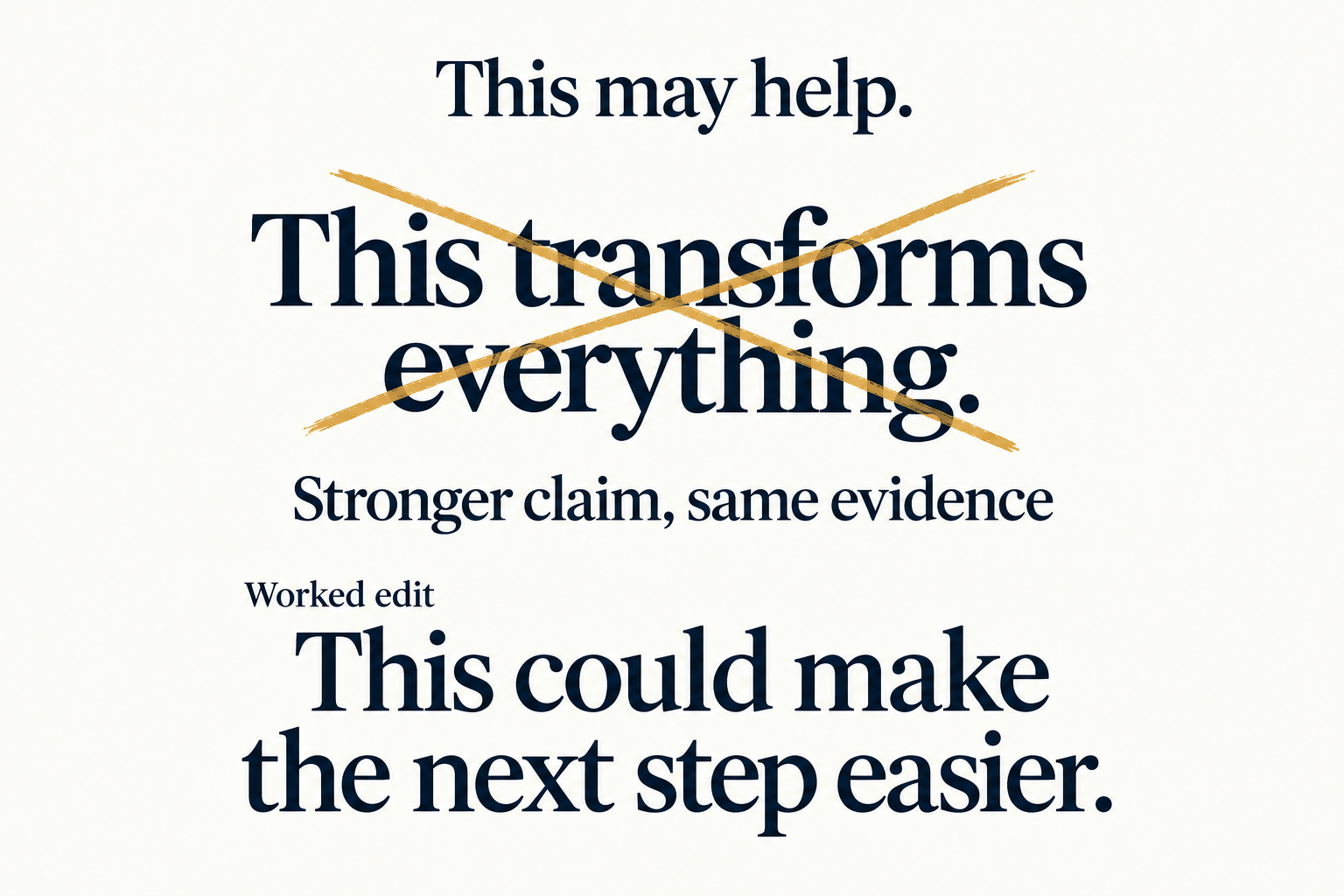
That last condition matters. “This may help” becoming “this transforms the process” is a change in the claim, even if the rewrite sounds more confident. Editing needs the same evidence discipline as research.
There is also a reason to keep your own choices visible. In an experiment by Anil Doshi and Oliver Hauser, access to AI story ideas improved ratings of individual stories while making the assisted stories more similar to one another. It was a short-story experiment, not a test of every kind of writing. Still, it gives us a concrete example of quality and variety moving in different directions.
For today's draft, keep one sentence because it makes the point in a way you would actually say. Revise another because it doesn't help the reader. You don't owe either sentence loyalty merely because a person or a model produced it.
Read the result aloud. Where do you naturally pause? Which phrase do you explain in simpler words as soon as you say it? That is useful editorial information. Keep the precision. Let the sentence breathe.