What disappears when you change the format?
A readable extraction can still lose the part you needed.
A paragraph can survive being copied out of a document almost untouched. A table is less forgiving. A decimal point, a column heading or a footnote can carry the difference between an accurate answer and a convincing mistake.
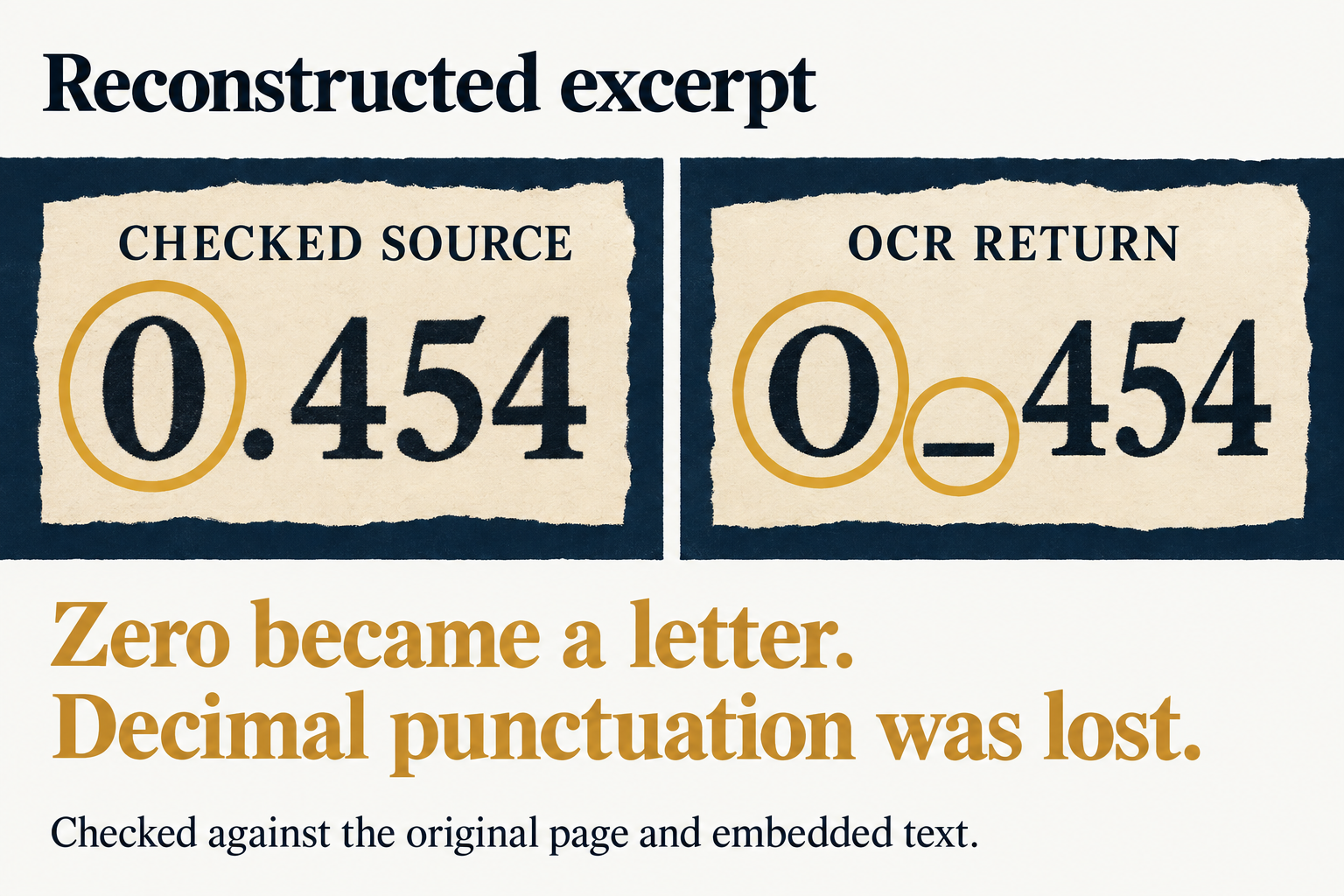
We ran into this while inspecting a dense page from an AI research paper. Optical character recognition—OCR—turned the image into text, but it mixed nearby table content and misread a numerical value. The process finished. The answer we needed still required the original page and checked embedded text.
That is why I want to add a question to the guide we've been building: What part of the source does this format fail to carry?
Text on a page and text inside a file
A digital PDF may contain text characters, their positions and other page elements. An extraction tool can read those characters without recognizing them from an image. But it still has to infer a useful reading order. Two columns that look separate to you can become an interleaved stream of text.
OCR takes a different route. It estimates characters from pixels. That is useful when the source is an image, but recognition and layout are both opportunities for error. Getting most words right doesn't establish that a particular table cell is right.
Our difficult sample was a rasterized digital page, not a damaged paper scan. In that sample, OCR changed 0.454 into a broken string beginning with the letter O. The original page and its embedded text let us resolve the selected value. That narrow failure is enough to justify checking the number; it isn't a claim that OCR always fails.
Check the thing your answer depends on
Suppose you're using a source to support a sentence about a study's results. The paragraph may describe the overall finding while a table identifies which condition produced it. If you inspect only the paragraph, you may miss the comparison that gives the number meaning.
This builds on Day 5's missing table relationships. There we needed to know which label belonged to which row. Here we also need to ask whether the representation preserved the value, the layout and the qualification accurately enough for the task.
For our example guide, I would add this instruction:
Identify the passage, table or image that supports the decision. Check it in a representation that preserves the relevant detail. If a necessary part is missing or unclear, describe that limit before drawing a conclusion.
That doesn't mean visually inspecting every page for every question. If all you need is an author's clearly extracted explanation, a table elsewhere may be irrelevant. Let the question determine the check.
The same problem follows your output
Once you turn that information into something for another person, you become responsible for another conversion. A wide table may be readable on your monitor and awkward on a phone. A diagram may rely on tiny labels. An image of text may become illegible when enlarged or squeezed into a narrow column.
W3C's reflow guidance addresses reading content when the available width changes, with exceptions for material that needs a two-dimensional layout. For our guide, the practical implication is to inspect the actual reading format. Keep essential explanations available in text, and preserve the relationships that make them meaningful.
Tomorrow we'll choose among a checklist, a branching instruction and a short explanation. Before choosing the most attractive one, decide what the reader cannot afford to lose.