What could someone else do with your draft?
A finished-looking page becomes useful when it supports a real action.
We've moved from rough notes to an outline, a draft, a clearer voice and a form that fits the task. There is one question left before we carry this work forward.
Could someone use it?
I mean something smaller and more observable than “Did they like it?” Could they find the input, take the first action, recognize an exception and know when to stop?
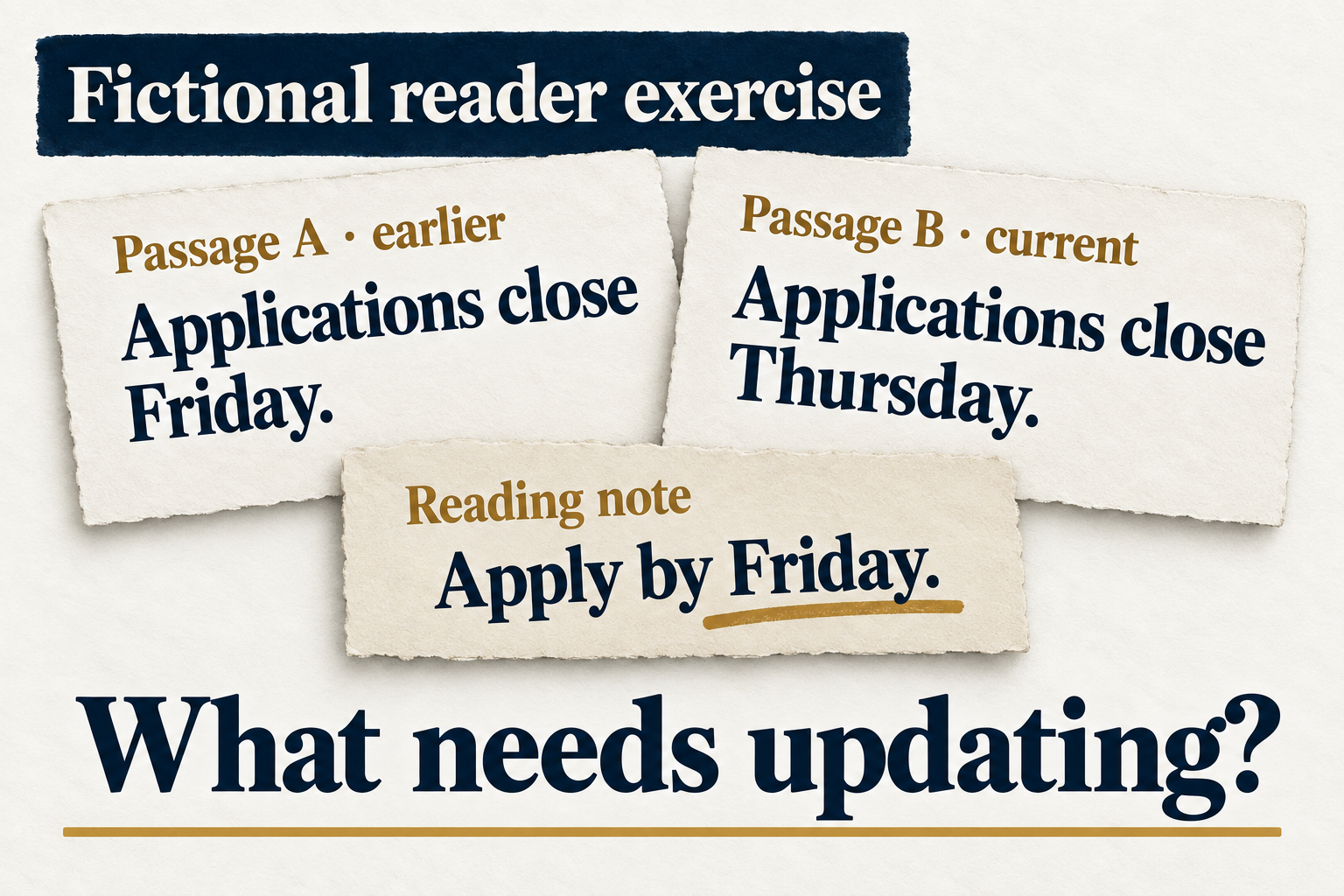
For our source-checking example, the task might be: compare two supplied passages and explain whether the second changes the advice in a short reading note. Give the reader the passages, the note and the guide. Their result should identify the relevant difference or explain why they cannot decide.
Here is a small fictional set of inputs you can use:
- Passage A, earlier: Applications close Friday.
- Passage B, current: Applications close Thursday.
- Reading note: Apply by Friday.
- Task: Identify what needs updating and explain which passage supports the change.
Ask someone to try it before showing them the expected answer: the reading note should say Thursday because the current passage changes the deadline. If Passage B is unavailable, the change cannot be established from these inputs. Record that gap rather than inventing a new date. This is an exercise to try, not a trial we have already run.
You don't need to ask them whether the guide is clear in the abstract. Watch where clarity becomes action and where it runs out.
Three kinds of evidence
Reading your own draft aloud helps you catch awkward language. Asking AI to critique it can expose missing steps. Having another person use it can reveal what they actually do with those steps. Each gives you different evidence.
In our procedure work, we kept that distinction. A fresh AI session could follow a limited source-checking path and recover from a deliberately wrong reference. The broader procedure still hadn't been independently followed by a human. We could report the useful result without promoting it into a claim we hadn't tested.
For your own review, write down the difference between what you expected and what happened. “The reader found the source but didn't know which saved version to compare” points to a repair. “Needs more clarity” leaves you staring at the page.
If the same guide contains ten instructions, one successful step doesn't validate the other nine. You can focus the trial on the part that matters most today, then say exactly what it covered.
Keep the useful difficulty
Sometimes the right result is that a person stops. If the needed source is missing, guessing would make the task look smoother while producing weaker work. A guide should help someone recognize that limit and carry an intelligible question forward.
This is where the finish line from Day 3 earns its place. A useful result might be a supported comparison. It might also be a clear explanation of the missing evidence and the next action needed to obtain it. Define those outcomes before reviewing the result.
If you haven't had a chance to try your draft with another person, keep that question open. You still have a usable candidate and a concrete test. You don't have to pretend the test happened to move forward thoughtfully.
Next we need to make this work easier to resume. A good draft can still disappear into a pile of files, stale instructions and half-remembered decisions. Tomorrow we'll organize around the next decision, so the next session starts somewhere better than “Where were we?”