Get organized around the next decision
A tidy collection of information can still leave the work stuck.
Imagine opening a folder called “Follow-ups.” Everything is in the right place. The documents have sensible names. You still can't tell who needs a reply.
Organization has to answer the question the work is asking.
For a follow-up, that question might be: What is the current status, and who should do what next? For the source-checking guide we've been building, it is: Which source needs attention, what do we know about it and what remains unresolved?
Both require something more useful than a pile of relevant information. They need state: a compact description of where the work stands now.
Make the next action depend on the current facts
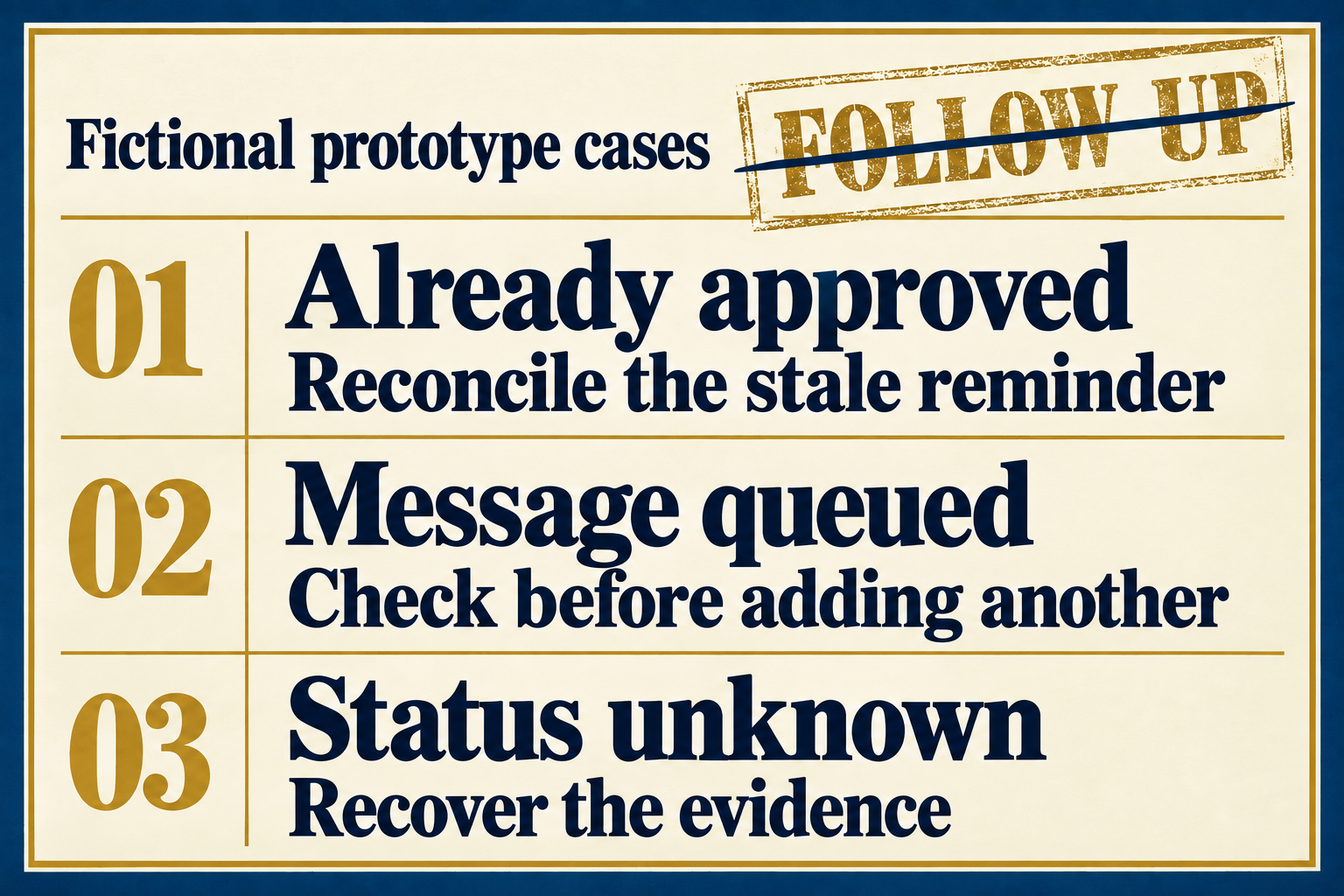
In an internal plumbing follow-up prototype, we used fictional estimates to examine this. One example had already been approved but still carried an old reminder date. Another had a message queued. A third had an unknown status because its source couldn't be opened. These were invented cases for a prototype, not customer results.
The cases made a practical point visible: “follow up” wasn't a sufficient next action. The approved estimate needed its status reconciled. The queued message needed to be checked before adding another. The unknown record needed its evidence recovered.
If an AI assistant sees only the old reminder, it can produce a perfectly polite message for a situation that no longer exists.
The same mistake can happen with a research note. An old draft says a conclusion is tentative. A later decision narrows it. A third file contains a proposed expansion that was never accepted. All three are relevant to the topic, but they do not have equal authority over the next step.
Give each piece a job
For a small project, I would separate three things conceptually, even if they live on the same page:
The material: original sources, supplied notes and the draft itself.
The current decision: what you have chosen, what that choice applies to and which version it concerns.
The next action: one concrete step, its owner and any condition that must be resolved first.
Here is a constructed continuation note for our guide:
Current draft: source-check guide, revision 2. Keep the original source and comparison copy. The instructions for an unavailable page are complete. The chart-only case still needs review. Next action: inspect that exception before asking someone to try the guide. Owner: the person preparing the guide.
You could put that in a text file, a notebook or your existing project tool. The useful part is the relationship between the current draft, the unfinished decision and the next action.
Adding AI doesn't eliminate the need for those relationships. It gives another reader access to them—provided the actual material is available and the current decision is identifiable.
Don't confuse a reminder with a reason
A due date tells you when something deserves attention. It doesn't establish that the proposed action is still appropriate. Check the state when the reminder arrives.
That's the connection back to our first week: the source still matters, the intended result still matters, and an unsupported assumption doesn't become stronger because it appears in an organized list.
Before adding another folder today, find one unfinished item and write its next decision. If you can't name it, your next action may be to clarify the problem. That is a useful place to begin.