Memory, notes and decisions are different things
Finding an old statement doesn't tell an assistant whether it should still guide the work.
“But I already told you that.”
It is a fair response when an assistant forgets something. It can also hide several different problems under one word: memory.
Was the information saved? Could the system find it? Did the current request include it? Did the assistant understand that a later decision replaced it?
Those are different failures, and they need different repairs.
Follow the information
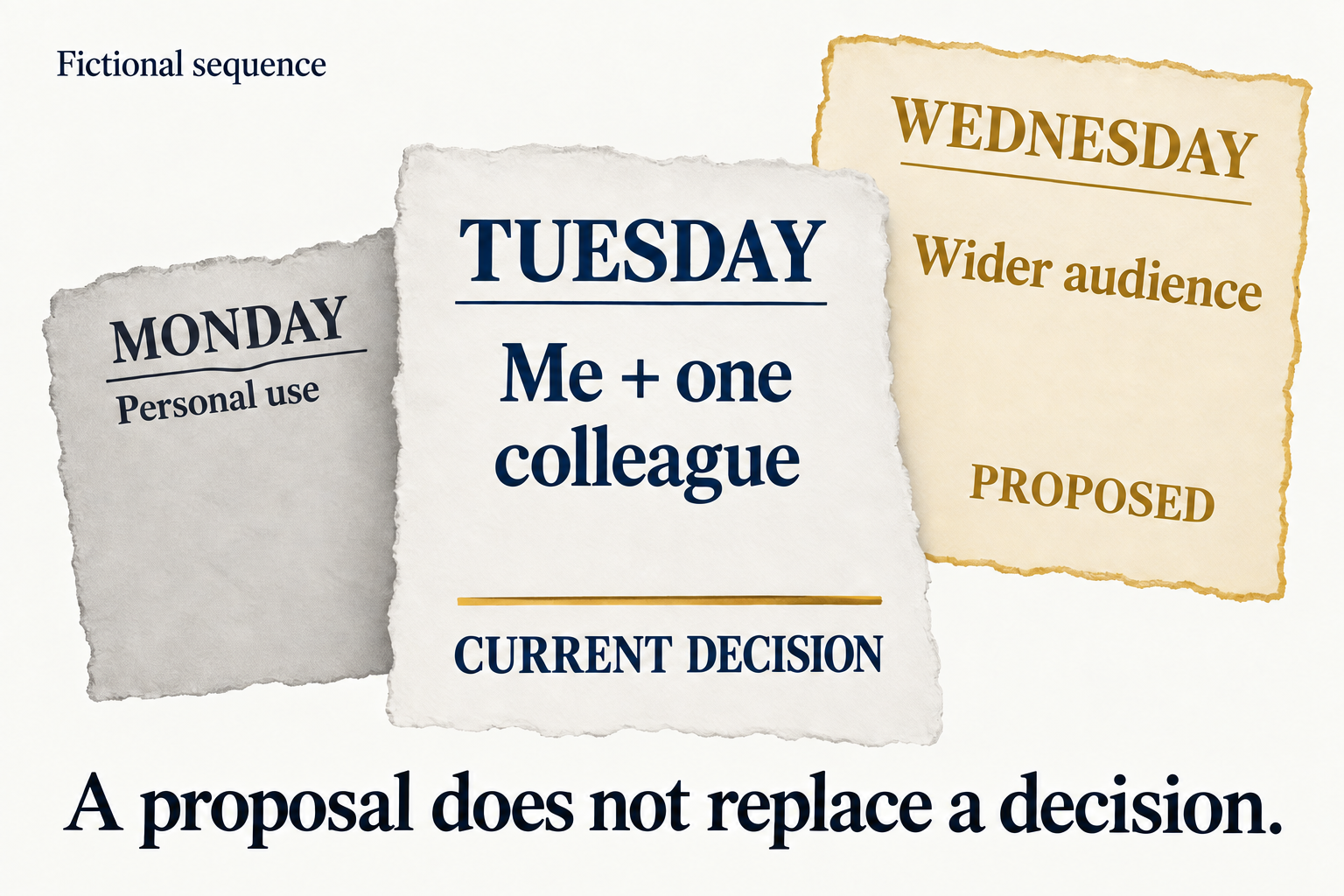
Consider this fictional sequence. On Monday, you plan a weekly reading summary for yourself. On Tuesday, you decide a colleague should also be able to use it. On Wednesday, a draft suggests sending it to a wider group, but you never make that decision.
An assistant that retrieves all three statements has remembered plenty. It still needs to distinguish the original plan, the accepted change and the unaccepted suggestion. Otherwise, “helpfully” expanding the audience is an error built from relevant information.
In a system that retrieves saved material, several steps are involved. Storage keeps the record. An index helps make it searchable. Retrieval selects material for the current question. Reading and reasoning determine what the selected material supports. A mistake at an earlier step can leave the final answer without the evidence it needs.
The LongMemEval research explicitly tests several abilities, including reasoning across sessions, handling time, incorporating updates and declining to answer when the needed information is absent. The authors also distinguish indexing, retrieval and reading. These are benchmark concepts; our system hasn't earned a score on that benchmark.
What they help explain is why “more memory” is an incomplete requirement. You need the right information, in a usable form, interpreted in the right relationship to the present task.
Preserve the old statement without putting it in charge
Our work distinguishes retained history from reviewed guidance. A saved conversation is evidence of what was said. It doesn't automatically become a lasting instruction. That separation lets us keep corrections and earlier reasoning without asking every future session to obey every past suggestion.
For your own project, you can apply the principle without building a memory system. Mark a current decision clearly, give it a date or version and say what it replaces when that matters. Preserve the old material where it can explain the change.
For the reading-summary example:
Current audience: me and one colleague. The earlier personal-only plan is superseded. Wider distribution was suggested but not approved.
That small note does work a search result cannot do by itself. It tells the next reader how the statements relate.
Yesterday's resumption note is one way to carry this forward. It points to current work; the fuller history remains available if a question requires it.
If an assistant makes a memory error, try naming the missing function. “Find the decision made after this draft” is more actionable than “remember better.” “Use the current audience decision; keep the wider-distribution idea as a proposal” resolves a conflict the model might otherwise smooth away.
The goal is continuity you can inspect. Remembering more is useful when it helps the next action respect what has actually been decided.