Do you need an agent for this?
Choose how much decision-making the task actually requires.
Before asking which AI agent to use, I would ask which decisions need to be made along the way.
If the answer is “none—the steps are already known,” you may be looking for a checklist, a script or a fixed workflow. If the next step depends on interpreting new information, an assistant may have a useful role. If it must choose tools and adjust its path repeatedly, you're getting closer to what people mean by an agent.
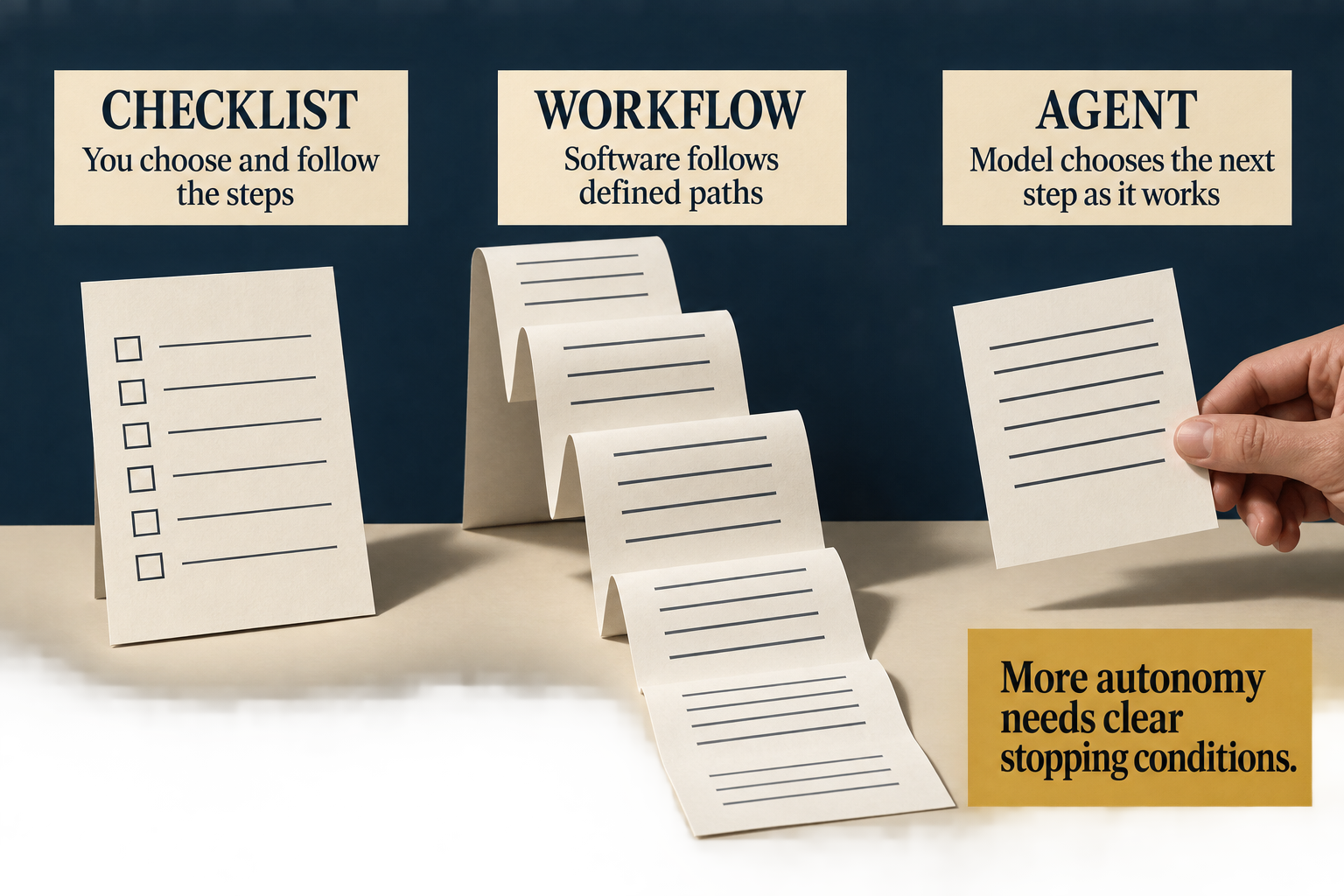
The name alone doesn't tell you how much control the system has. Look at the actual behavior.
Four ways to do the same small job
Take our source-checking task. A person can follow a checklist: open the saved source, compare the relevant material and record the result. That may be entirely sufficient.
A single AI request could compare two supplied passages and suggest what changed. The person still supplies the inputs and reviews the conclusion.
A fixed workflow could fetch a page, extract text, calculate a difference and ask a model to summarize that difference. The sequence is designed in advance, including what happens if a step fails.
An agent could choose where to look next, decide that a table needs another inspection route and select a tool based on what it finds. That flexibility can be useful, but now you need to understand and review more decisions.
Anthropic's engineering guide distinguishes predefined workflows from agents that dynamically direct their process and tool use. It recommends starting with simpler approaches and adding complexity when justified. That is vendor engineering guidance, not an independent test proving which design is best for your task.
In our source-checking work, we explicitly separate obtaining material, comparing meaning and reviewing a proposed knowledge change. This gives us places to inspect a failure or decision. We haven't established that making every stage autonomous would improve the result.
Follow the consequence of each choice
If an assistant chooses the wrong paragraph to summarize, you may catch it before using the answer. If it chooses to overwrite the saved comparison copy, it can damage the evidence needed to review the answer. Both are tool-assisted actions; their consequences differ.
Think about what the system can read, what it can change and what requires your judgment. Then examine yesterday's awkward cases. Can it tell the difference between unavailable information and a negative result? Can it avoid repeating an action that's already in progress? Can it return a useful partial result when it can't continue?
For an agent, the loop often looks like this: inspect the situation, choose an action, use a tool, read the result and decide again. That repeats until it reaches a stopping condition. Each additional turn creates an opportunity to adapt and another place where a mistaken interpretation can affect what follows.
Your design needs a recognizable finish line and a way to return uncertainty. “Keep working until it's done” is hard to evaluate when “done” hasn't been defined.
For the routine you're building, circle the steps that actually require interpretation. Keep the predictable steps predictable. Give AI a job where its flexibility serves the task, and keep enough visibility to judge what it did.
Tomorrow we'll put those choices together into a repeatable routine. The useful outcome is a process you can run and inspect, whatever label you give it.