Count the work you usually leave out
A recurring routine has a cost after the first successful run.
On Day 7, we counted the work between asking for a draft and having something usable. Now we have a routine. The question has grown: what does it take to keep this useful?
A source moves. A saved instruction becomes stale. A tool returns a slightly different format. Someone has to notice, decide what matters and repair the affected part.
That work belongs in the picture.
In September, I reported that two reviewed outputs were useful and the work felt easier overall. That was encouraging. But the broader record still included corrections and effort we hadn't measured. Two helpful responses don't tell us what the arrangement will require across ordinary work.
Choose the unit you care about
“Time per AI response” can reward a routine that produces lots of quick fragments. “Time per usable result” asks a better question for most of the work we've discussed.
For our guide, a usable result might be one source check with the supporting material, a clear finding and an intelligible next action. An unresolved check can still be handled well if it accurately identifies what's missing. Don't count a confident but unsupported conclusion as success merely because it closes the item.
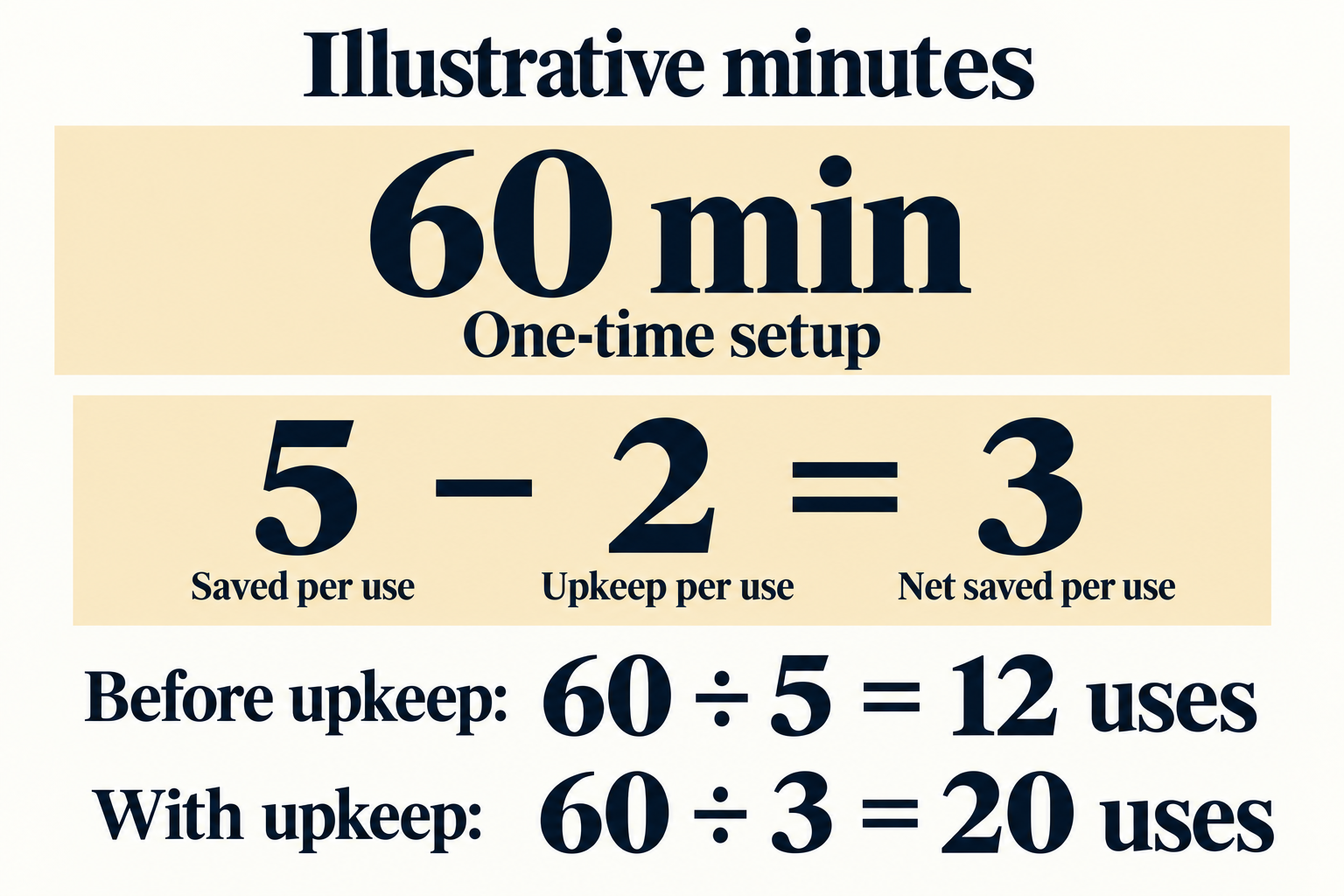
Then distinguish initial setup from recurring effort. Here's a constructed calculation: suppose preparing a routine takes 60 minutes, and it subsequently saves 5 minutes on each comparable completed task. Ignoring maintenance, it takes 12 uses to recover the setup time. If maintenance averages another 2 minutes per use, the net saving is 3 minutes and the same arithmetic becomes 20 uses.
Those are illustrative numbers, not our measured savings. The calculation only works if the tasks meet a comparable quality standard and the supposed saving actually occurs. A rarely used routine may never reach that point.
Keep the log smaller than the job
A short record can carry the essentials: what you completed, active attention, waiting time, corrections and any maintenance that affected the run. Record a quality problem in words when a single score would hide it.
If you work on another task while a process runs, don't add the same minutes twice to your personal effort. Elapsed time still matters if someone is waiting for the result. Keep the two measures separate.
Also count work that disappears from the final copy. Finding the right source, removing an unsupported sentence and restoring a lost exception are part of producing the result. A clean final document doesn't reveal how expensive it was to reach.
You may decide the routine is worth keeping because it helps you finish something you otherwise avoid. That is a real kind of value to consider. Describe it as completion, confidence or reduced friction instead of turning it into an invented time saving.
For the next few comparable uses, keep a small honest log. Tomorrow we'll make the comparison fairer, so the easiest task doesn't quietly become the evidence for your favorite approach.