What should stay in your hands?
Give your attention to the decisions that change what happens next.
A draft reminder and a sent reminder can contain exactly the same words. They are still different actions.
One gives you something to inspect. The other reaches another person and creates an expectation.
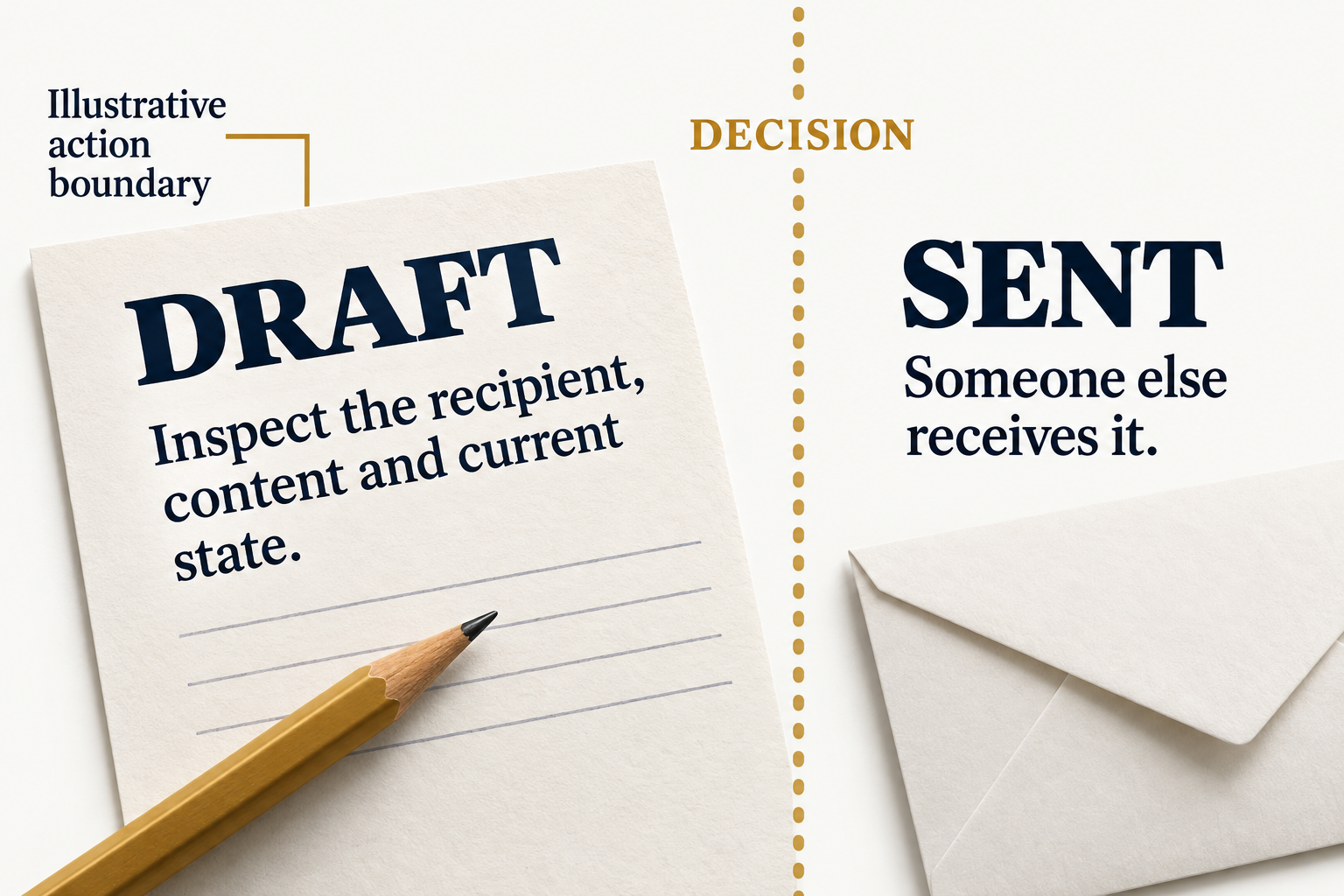
That is a useful starting point for deciding how much to delegate. Ask what changes when the action happens, how easily you could correct it and what evidence you need before allowing it to proceed.
In our plumbing prototype, a fictional customer request changed the scope of the job. The appropriate next step was to route it to the estimator, not let a reminder draft invent a new offer. In our actual cross-app work, returned contributions are inspected before being incorporated. Both reflect the same working choice: prepare useful material while keeping consequential decisions visible.
Make review something you can actually do
“Human review” sounds reassuring, but the phrase doesn't say what the person sees or checks. If a reviewer receives only a smooth summary, they may lack the source material needed to challenge it.
For a factual claim, show the supporting passage. For a changed document, make the substantive changes discoverable. For a proposed action, show the recipient, the content and the relevant current state. The review should be placed before the consequence it is meant to govern.
This also gives AI a clearer job. It can prepare the comparison, identify a missing input or draft a response for an authorized person to decide about. Those are useful contributions even when final authority stays elsewhere.
A 2025 study of knowledge workers examined self-reported critical thinking in AI-assisted work. Higher confidence in AI was associated with less reported critical thinking, and participants described work shifting toward verification and integration. This was survey evidence, not proof that AI causes lasting loss of judgment.
For me, its relevance is the practical question it raises: have we made checking a real part of the task, or merely assumed that someone will do it?
Keep the boundary specific
You don't need to approve every minor formatting choice to remain responsible for the work. You do need to know when an assistant is changing a claim, making a commitment or treating an unresolved suggestion as a settled decision.
For the routine you built on Day 21, mark those moments. A model may compare supplied source passages. You decide whether its interpretation supports a change to the note. If the note guides someone else's work, that decision may belong to the person responsible for that guidance.
The right boundary depends on the task. Start with the actual consequence, then design the evidence and review around it.
Tomorrow we'll try one small part without AI. That gives you another way to inspect your role: can you explain the judgment you are being asked to make?