Keep it, change it or stop doing it
Your routine has to answer to the purpose you chose.
You don't owe a workflow continued use because it took effort to build.
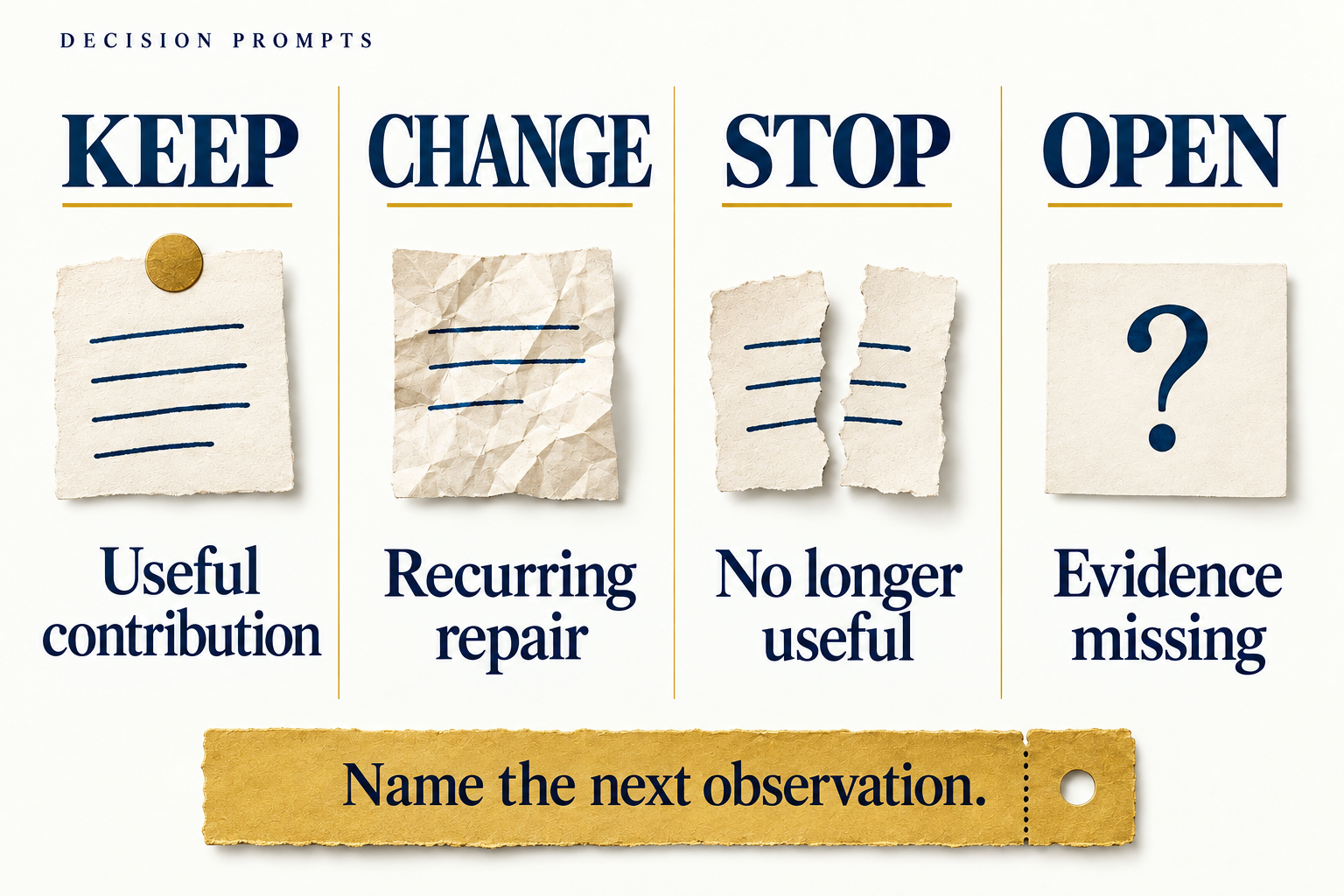
You also don't have to throw it away because one part was frustrating. The useful decision may be smaller: keep the source comparison, simplify the handoff, remove an unnecessary rewrite.
Go back to the task you chose on Day 1. What would have made this month useful? Now put that question beside the work you actually tried.
If you haven't tried it yet, that's your answer for now: you have a candidate, not a verdict. There is no need to manufacture a success story to reach the end of the series.
Keep the part with a clear contribution
Perhaps AI helped you identify missing prerequisites in a guide. Perhaps a resumption note made the next session easier to begin. Perhaps checking the original source caught a mistake you could have carried into a decision.
Keep the contribution specific. Record the task, the conditions and the result. “This helped me compare two supplied passages” gives you a useful starting point next time. “AI is better at research” reaches far beyond it.
In our September review, I described two outputs as useful and reported lower overall effort. We still needed more evidence about whether that benefit would last and how much work the whole arrangement required. That combination allows a sensible next step: continue the useful work while keeping the broader claim open.
Change the part that creates avoidable effort
Use the log from Day 22 and the comparison from Day 23. Does the same kind of repair keep appearing? Is the input missing a decision? Does the model keep trying to answer a question the source can't support?
Change one important part at a time when you can. Otherwise, a better result may leave you unsure which change helped. You might add the current decision, narrow the requested output or move a source check earlier.
Then revisit the awkward case from Day 19. An improvement on the ordinary path shouldn't quietly remove the exception that kept the result honest.
Stop the work that no longer serves the goal
A routine may demand more setup and repair than the task warrants. It may solve a problem your existing tools already handle. Or the task itself may no longer matter.
Stopping can be a well-supported decision. Preserve enough to know why, especially if you might revisit it under different conditions. You don't need to preserve the obligation to keep using it.
There is also a fourth answer: not enough evidence yet. Name the next observation that would help you decide. One comparable use may be more informative than another hour of discussing whether the approach should work.
I would summarize the decision in a few lines:
Keep [the useful part] for [the task and conditions]. Change or stop [the part that created trouble] because [what happened]. Reconsider when [a concrete condition or new observation].
That record brings the month back to its starting point. The purpose was to make AI useful in work you care about. You get to decide how much of it belongs there.
Tomorrow we'll gather the pieces into a compact working kit. Keep only the parts you have a reason to use.