Your working kit, on one page
Keep the questions that help you begin, check and continue.
You shouldn't need to reread twenty-eight posts to start the next task.
The useful pieces can fit on one page. Think of this as a small set of questions to carry into your existing way of working. Add detail when the task needs it; leave irrelevant fields alone.
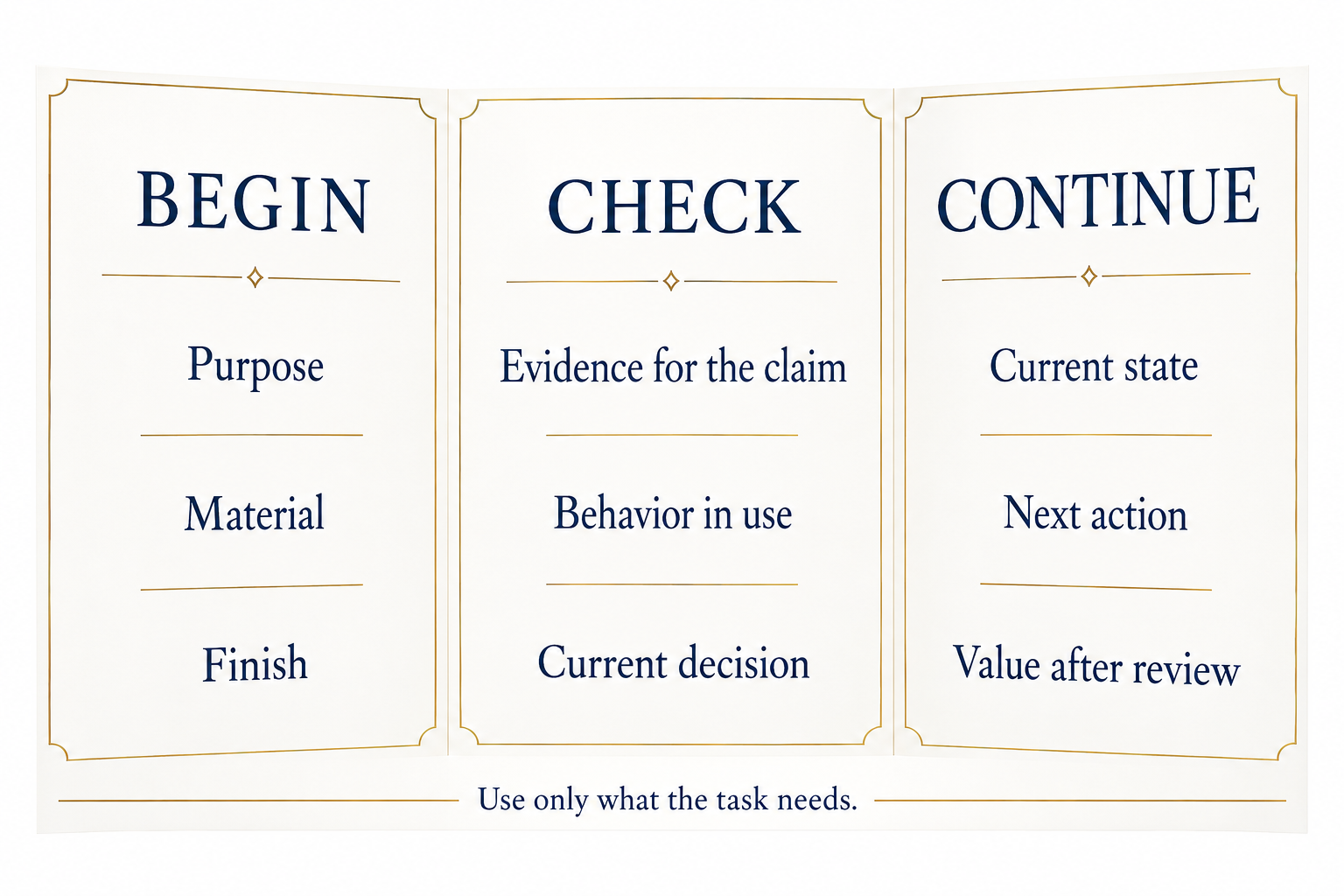
Before asking
Purpose: What am I trying to accomplish, and who will use the result?
Material: Which sources, notes or files does the work depend on? Can the person or app actually inspect them?
Finish: What would an acceptable result look like? What should happen if necessary information is missing?
These questions come from the first week. They prevent a fluent answer from choosing the task on your behalf.
Before relying on the answer
Support: Which part of the source supports the claim? Did the output preserve the condition, label, date or relationship that matters?
Behavior: Does the draft tell someone enough to act? What happens in the awkward case?
Decision: What am I accepting, what am I changing and what remains a proposal?
This is the work of the second and third weeks. An answer becomes useful through its connection to evidence and action. A polished appearance doesn't supply that connection.
Before leaving
Current state: Which version matters now? What has been decided?
Next action: What should happen first when the work resumes, and who owns it?
Value: What did the result require, including review and correction? What should I keep, change or stop?
Our own continuity work depends on explicit current context and inspected returns. The kit borrows that principle without asking you to copy our entire system. A short note in a tool you already use may be enough.
Here is a fictional filled example:
Purpose: check whether one source still supports my reading note. Material: the note, the current source and its saved comparison passage. Finish: a supported finding or a clear unresolved question. Check: inspect the sentence and its qualifying footnote. Current decision: don't broaden the claim beyond the studied population. Next action: recover the missing table before deciding about the numerical sentence. Value: record the attention spent and whether the result was usable.
The example stays specific enough to guide work. “Be accurate and helpful” would express a preference, but it wouldn't identify the missing table or the decision waiting on it.
Copy this into your next task
Purpose and reader: [ ]
Material available: [ ]
Acceptable finish; missing-information response: [ ]
Supporting passage and important conditions: [ ]
Ordinary action and awkward case: [ ]
Accepted decision; changes; open questions: [ ]
Current revision; what it replaces: [ ]
Next action, owner and prerequisites: [ ]
Total work required; keep, change, stop or gather evidence: [ ]
For each actual use, add a short comparison-log entry: task and approach; supplied inputs; difficulty or interruptions; active minutes; elapsed minutes; setup or upkeep; quality result; corrections; and next decision. Leave measurements you do not have blank. A blank is not zero, and a failed attempt still belongs in the record. Avoid counting overlapping waiting periods twice as active work.
Use comparable tasks and the same finish criteria, and note whether you reviewed your own work or someone else did. The log can inform your next choice; it does not prove AI caused a difference.
Everything needed to use the kit is here in the post. Copy the blank lines into your notes or use the questions on paper. Nothing is recorded until you add your own observations.
Don't turn the kit into a form that takes more effort than the task. Start with the question most likely to prevent your usual mistake. Add another when experience gives you a reason.
Tomorrow we close the month by choosing what to explore next. Bring the part that helped, the part that resisted and the question you still want answered.