What should we explore next?
Start the next step with what the work has shown you.
At the beginning of this series, I asked what would make a month of AI useful to you.
I still think that is the question to keep.
We began with the person and the task. We looked at what a language model does, how context affects an answer and why a plausible response still needs support. Then we moved into making something: choosing a structure, examining a draft and helping another person use it.
From there, we followed the work across sessions. Current decisions, handoffs and exception cases gave us a way to build a routine we could inspect. The final week asked whether the routine deserved to stay, including the work of checking it and the understanding we wanted to retain.
That is the path these thirty posts offer. What happened when you followed it is something only your actual experience can tell us.
A useful result can be smaller than you expected
Maybe you have a guide you can use. Maybe you have a clearer way to resume a project. Maybe you discovered that one part of a task benefits from AI while another works better with a simple checklist.
You may also have found an unanswered question or decided that the task you chose wasn't worth automating. Those possibilities belong in an honest review. They don't need to be rewritten as dramatic transformations.
In our own work, the evidence has included useful returns, corrections to unsupported claims, source details that needed another inspection route and decisions that had to remain visible across apps. We have also received positive usefulness feedback without establishing every broader claim about lasting effort reduction. That mix is the experience behind the approach we've shared here.
I want to keep building from that kind of evidence: what the task required, what happened and what the result gives us reason to do next.
Choose a direction with a real question
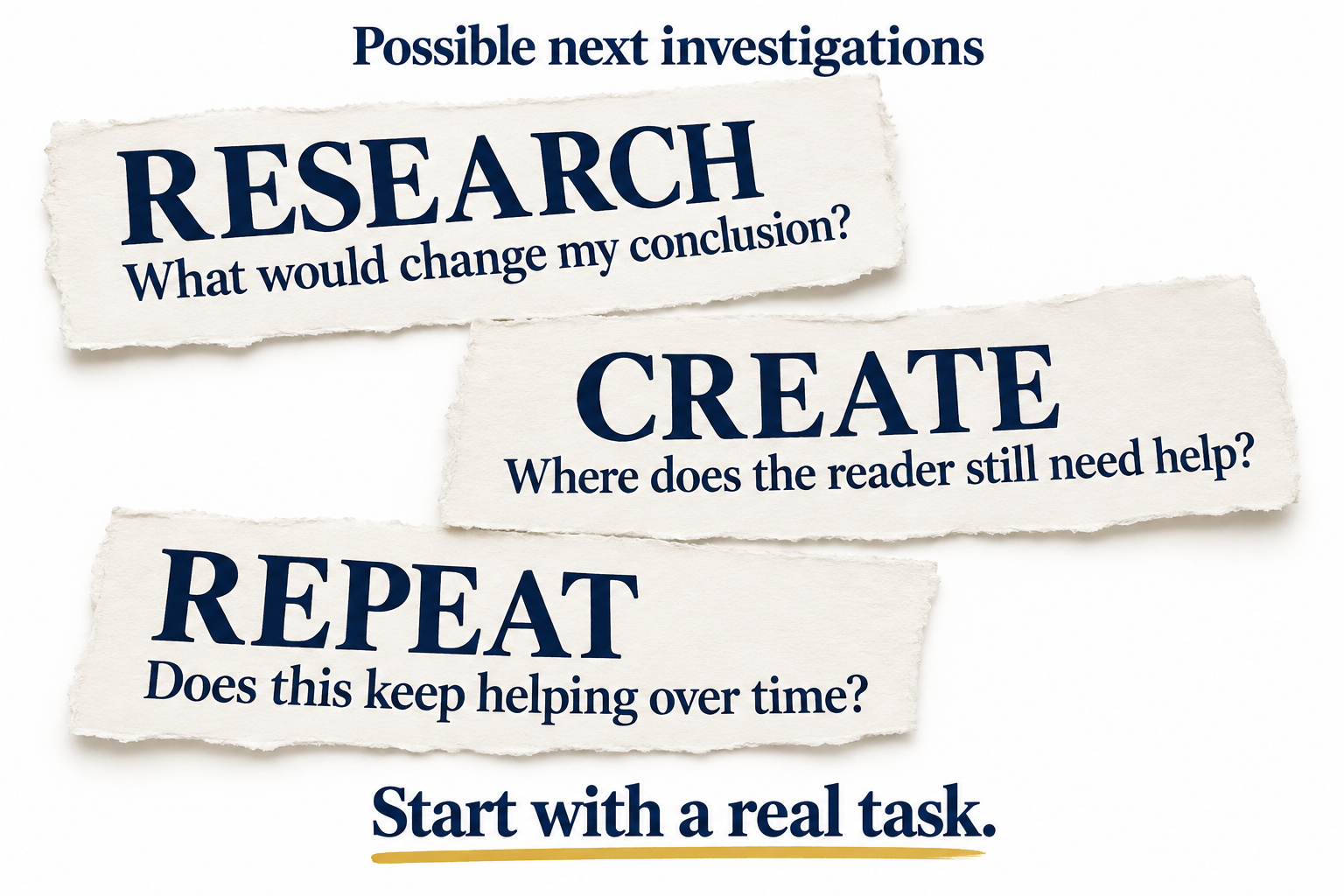
If research was the useful part, the next step might be a deeper source investigation: follow one claim through its original evidence, competing explanations and later updates. The question could be, “What would change my conclusion?”
If creating something was the useful part, we could take one artifact through a more demanding reader trial. The question could be, “Where does a person still need help that the draft doesn't provide?”
If continuity and routines mattered most, we could follow one recurring task over several actual uses. The question could be, “Does this keep helping once maintenance and exceptions enter the picture?”
Those are possible next investigations, not promises of outcomes we already know. Each would need a real task and evidence worth examining.
Tell me about the task
If you tried something, share what you were trying to do, where AI helped or complicated it, and what you would like to understand next. A short example is enough. Leave out private information that isn't needed to explain the question.
If you mostly read along, tell me which idea you'd want to see demonstrated more fully. Interest in a topic and evidence that a routine worked are different kinds of feedback; both can help shape what comes next when we keep their meanings clear.
You can return to the working kit whenever a new task appears. Choose the purpose, supply the material, define a useful result, inspect what comes back and leave a place to continue.
AI can be part of that work. Your purpose gives it somewhere to go.